Two EGO Flip-Modes
The Bimodal Ego — BLOWHARD or BLOWOUT
The Narcissist's ego is a tyre: either dangerously overinflated — strutting, entitled, invincible — or catastrophically blown out, collapsed into self-pity and victimhood. There is no middle ground, no stable running pressure. The flip between these two states is instantaneous, unpredictable and weaponised.
The Bimodal Ego — visualised
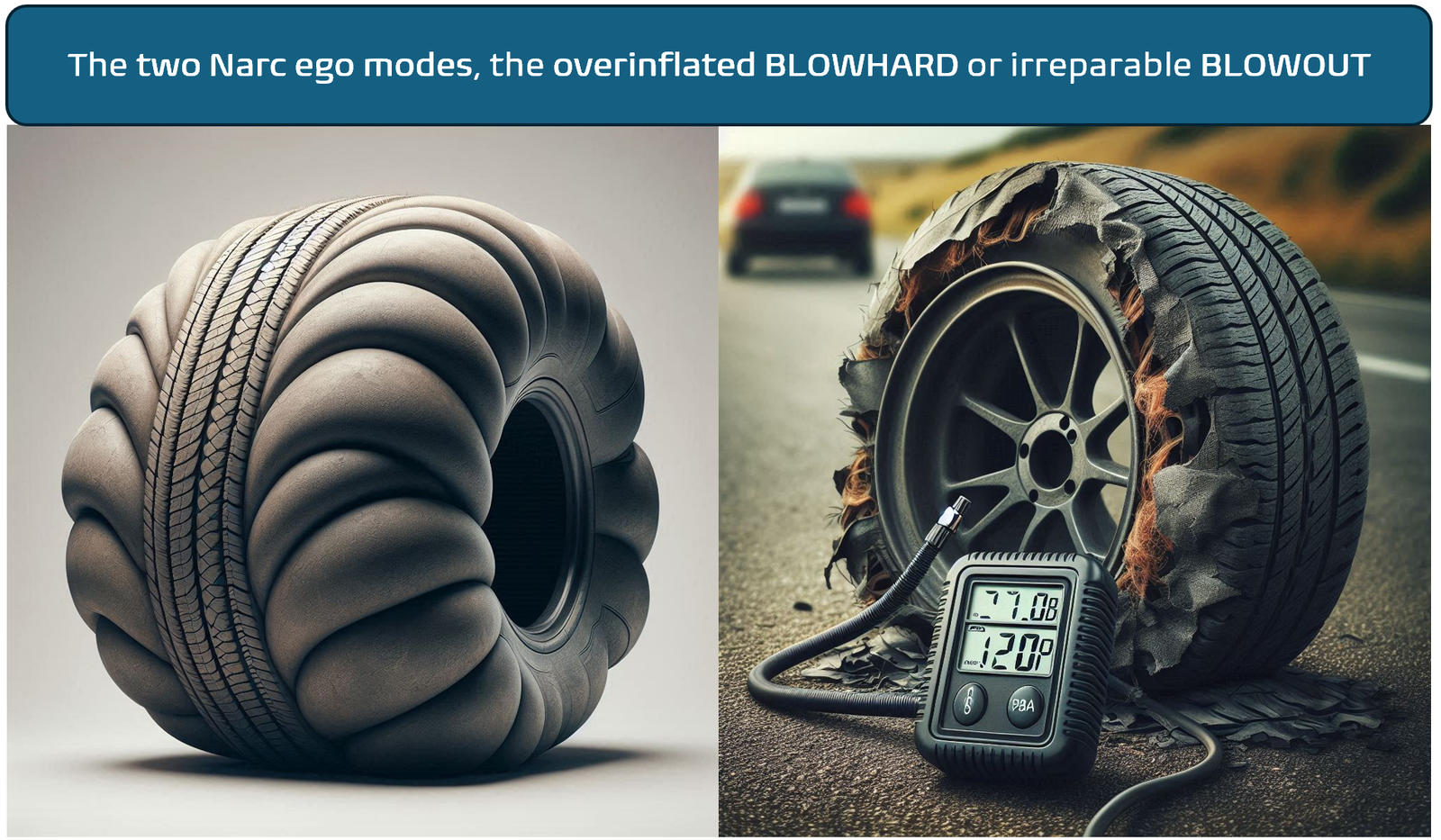
The two Narc ego modes: the overinflated BLOWHARD or irreparable BLOWOUT
“Have you witnessed a patient flip from charm to aggression the moment you challenged their narrative?”
The App’s Bimodal Ego module tells you exactly where in the flip-cycle you are — and how to manage it safely.
The BLOWHARD — Overinflated Supremacy
In BLOWHARD mode the Narcissist is running dangerously above pressure. He is the invincible mini-god: strutting, entitled, brimming with grandiosity and contempt. Superiority is not a mood — it is his oxygen. He name-drops, lectures, interrupts and dominates. He cannot be wrong, cannot be corrected and cannot be questioned. Any challenge to his status is met with immediate hostility.
"An invincible mini-god — everything he touches turns to gold, at least in his own retelling."
- Grandiose self-narration — the hero of every story he tells.
- Name-dropping and title inflation — associating with the important.
- Contempt for those he judges beneath him — the Charm-Offensive turned cold.
- Any refusal or setback is a direct attack on his identity.
The BLOWOUT — Catastrophic Collapse
When the pressure chamber fails — a public humiliation, a refused demand, an exposure — the ego doesn't deflate gradually. It shreds. In BLOWOUT mode the Narcissist becomes the world's greatest victim: worthless, abandoned, suicidal, desperate for attention. The 999 call arrives. The Paramedics arrive at a scene of theatrical crisis with no medical emergency.
"Worthless one day — the tyre shreds, the rim scrapes the road. The 999 call follows."
- Sudden, extreme expressions of hopelessness — "I can't take any more."
- Fabricated or exaggerated medical emergency — the Somatic Patient profile.
- Self-pity deployed as entitlement — demanding unlimited care and attention.
- Rapid mood recovery once the desired response is secured — mask back on.
The instantaneous flip
What makes the Bimodal Ego clinically dangerous is the speed of transition. There is no warning, no ramp-up. A perceived slight — a clinical challenge, a sceptical question, a refusal to convey — can flip a BLOWHARD into a BLOWOUT in seconds. Equally, securing the desired supply flips BLOWOUT straight back to BLOWHARD. To the attending crew this looks like a miraculous recovery. It is a script change.
Entitled. Grandiose. Dominant. Contemptuous.
Victim. Desperate. Collapsed. Crisis-calling.
Neither state is authentic. Both are supply-extraction strategies, each optimised for a different target.
The clinical impact
BLOWOUT is a performance, not a medical emergency. The Somatic Patient has rehearsed his symptoms from Diagnosis-by-Google.
BLOWHARD mode flips to aggression when challenged. The "recovery" catches crews off-guard — the mood switch feels confusing and disorienting.
Each false call consumes an emergency resource that a genuine patient needed. His playtime is potentially someone else's fatality.
How to recognise it
- Mood shifts that are faster and more extreme than any genuine mental-health crisis.
- Rapid "recovery" once crew attention is secured — signs that vanish on the way to hospital.
- Entitlement language even in distress — "You HAVE to help me", "Do you know who I am?"
- Symptoms that match a researched diagnosis perfectly but lack physiological confirmation.
- BLOWHARD hostility when clinical scepticism is applied — challenge = insult to his status.
- Repeat caller history — the same pattern, the same unverifiable crisis, the same address.
Two Ego-Flip Modes — annotated diagram & reference sheet
Full clinical reference: BLOWHARD vs BLOWOUT, the instantaneous flip, and recognition cues.